Kuroko no Basket Dj – Ryouta-kun from Aomine-san’s Household Learns About Sex? by ESCAPIZMA/ Hachiko [Eng] online for free on Yaoi Manga. Read the latest chapter of Kuroko no Basket Dj – Ryouta-kun from Aomine-san’s Household Learns About Sex? by ESCAPIZMA/ Hachiko [Eng], in high quality, no download needed.
Be the first to ask a question about Under the Suits
They'll All Find Out That It's Inside Me! (Having sex with my classmate who's hiding under the covers)
"This paper examines gender marking in two contemporary novels: the Japanese translation of Bridget Jones’s Diary (BDJ , translated by Yoshiko Kamei in 1998) and the Japanese novel Kitchen (by Banana Yoshimoto, 1988). As a benchmark to see the gap between literary language, supposedly authentic women’s language, and real women’s language, a linguistic analysis of Japanese women’s conversation (Okamoto and Sato 1992) is used. I begin by placing these two novels within a broader context where gender marking in many forms of written communication serves a distinctly ideological agenda. A literary movement known as genbun-itchi in the Meiji period was a key to the implantation of women’s language in literature. During the period, gendered language was promoted by the literary movement, which played a crucial role in spreading the belief that women and men should speak differently (Ueno 2003: 24). Thus the linguistic norms of gendered language use in literature were established. That is, literature functioned as a mediator of the norms. A Japanese translation of the Russian writer Turgenev triggered the movement, and the convention of gendering language in literature started from translation. Modern Japanese prose benefited considerably from translation due to the conventions in the Japanese literary world. After more than a century since the genbun-itchi movement, women’s speech in literature is still artificially represented (ibid), and the over-feminising tendency in Japanese translation and literature shapes gender ideology in Japanese society."
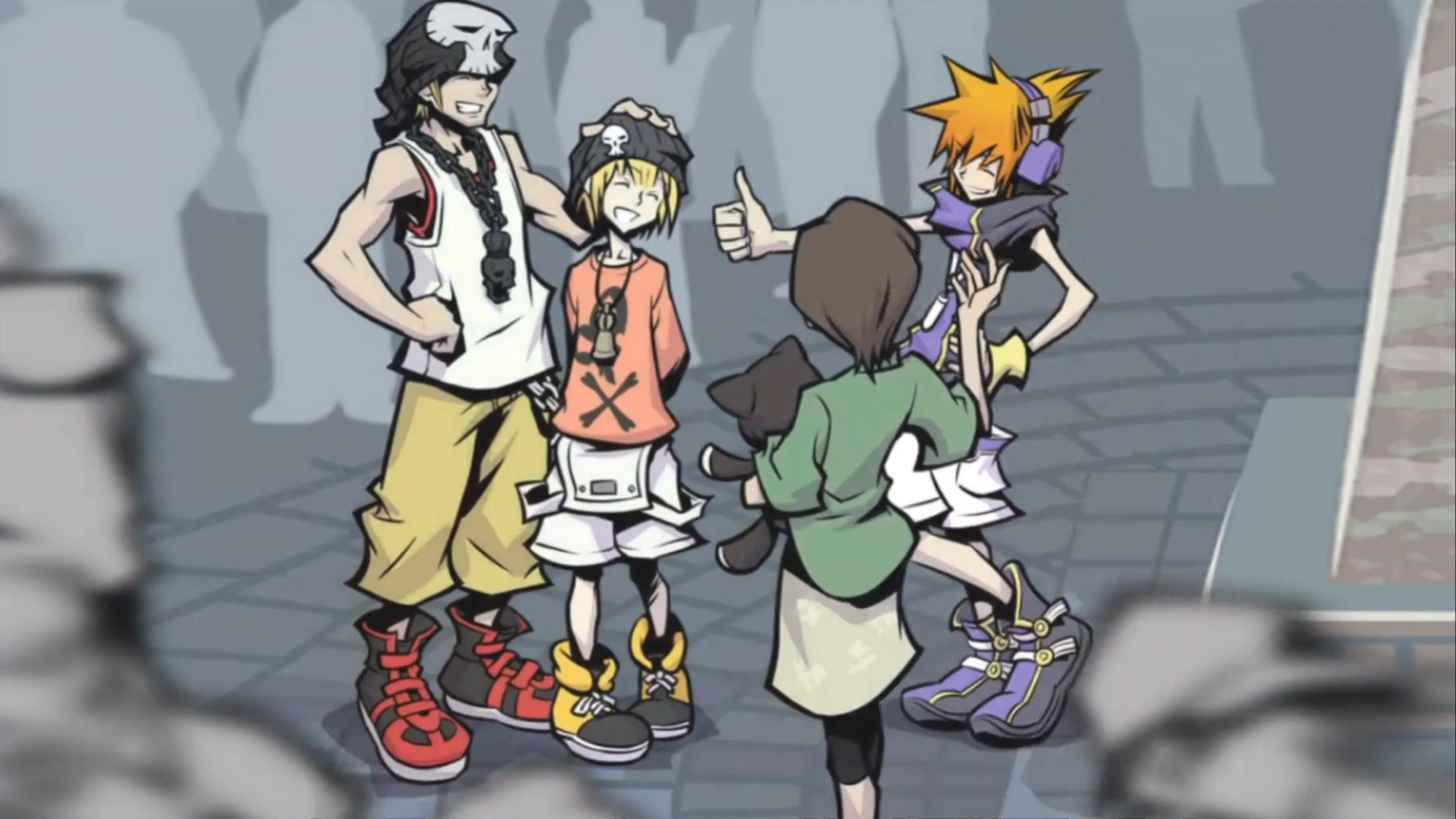
Beat is a muscular teenager with blonde hair and blue eyes. He wears a black beanie with a large skull on the front, a white tanktop with either either red lacing or a red sleeveless shirt under it, beige yellow board shorts, and red-and-black shoes. He accessorizes with a black chain skull necklace, and a black bracelet on his left wrist, and a chain dangling on his pants. It is implied his preferred brand is
Beat tries his best to act tough, but is actually soft underneath, getting embarrassed whenever people realize this. He also despises the name his parents chose for him because he finds it uncool and embarassing, preferring his nickname Beat over Daisukenojo, which reflects his soft nature. At the same time, Beat is very loud and impulsive, and tends to come to conclusions without reason.
At the end of the game, he is seen meeting Neku in front of the Hachiko, with Rhyme by his side.
After the Wicked Twisters took out their target at the end of the day and heard how the Ruinbringers remained in first place once again, Beat expressed his understanding of why Kanon would want to overthrow the number one team.
In the ending, Beat and Rhyme both meet up with Neku and Shiki by Hachiko, and the friends are reunited. Beat then later partners with Neku again in A New Day. At the end, Beat is shown to be panicked at Neku’s sudden death.
In the ending, Beat is seen at Hachiko happily waiting for Neku along with Rhyme.
Beat’s cards are generally considered the most complicated of the three partners, though this is balanced by the high number of Fusion Stars he can potentially rack up with a good setup. In order to gain stars with Beat, the player must successfully line up pairs of the same suit in consecutive rows, before executing them. Each ending on the combo tree will lead to one of a pair of cards. After gaining that pair, it will appear at the top of the screen, along with a red arrow signifying where the next pair of cards will be placed. There are four unique suits; a red heart [









![[4K] Melody give you some support from under the desk](https://hentai44.com/wp-content/uploads/2026/09/4K-Melody-give-you-some-support-from-under-the-desk-364x205.jpg)